
 English
How to Price Your Freelancer Services for International Clients

Pricing your freelancer services can be challenging, especially when you work with clients in other countries. Charge too little, and you may struggle to cover your time, tools, business expenses, and payment fees. Charge too much without communicating your value, and you may lose suitable opportunities. So, how much should you charge as a freelancer?
There is no universal rate that works for everyone. Your price should reflect your experience, operating costs, project scope, time commitment, the value you provide, and the cost of receiving international payments.
In this freelance pricing guide, you will learn how to set your rates as a freelancer, choose the right pricing model, create a professional rate card, prepare an invoice and receive payments from international clients.
How to calculate your freelance rate
Before comparing your rate with what other freelancers charge, calculate the minimum amount you need to earn for freelancing to remain sustainable.
A simple formula is:
Minimum hourly rate = Monthly income target ÷ Realistic monthly billable hours
Your monthly income target should include more than your personal expenses. It should also account for the cost of running your freelance business.
Consider:
- Your desired take-home income
- Internet and electricity
- Software subscriptions
- Equipment and maintenance
- Professional development
- Taxes and statutory obligations
- Savings and emergency funds
- Marketing and client acquisition
You should also be realistic about your billable hours. A freelancer may work 160 hours in a month but only bill clients for 80 to 100 of those hours.
The remaining time may be spent on proposals, discovery calls, administration, marketing, revisions and chasing payments.
A simple freelance pricing example
Assume you want your freelance business to generate $2,000 per month. You estimate that you can complete 80 billable hours each month.
Your starting hourly rate would be:
$2,000 ÷ 80 = $25 per hour
This does not mean every project must be billed hourly. The calculation gives you a baseline for deciding whether a project price is sustainable.
For example, if a project will take approximately 20 hours, your minimum starting price would be:
20 hours × $25 = $500
You may then add charges for urgency, additional revisions, specialist research, licensing, project management, or complex deliverables.
How to price your freelance services in 6 steps
1. Calculate the true cost of delivering the work
Your price should cover everything required to complete the project, not only the time spent producing the final deliverable.
For each project, estimate:
- Research time
- Meetings and calls
- Planning
- Production
- Editing or testing
- Revisions
- Client communication
- Project management
- Delivery and handover
- Follow-up support
A design project that takes five hours to execute may require several additional hours for briefing, ideation, presentations, and revisions.
The same applies to writing, software development, consulting, video editing, social media management and other freelance services.
If you only charge for production time, you may end up doing a significant amount of unpaid work.
2. Choose the right freelance pricing model
Your approach to freelance pricing should depend on the scope, duration, and expected value of the work.
| Pricing model | How it works | Best for | Main consideration |
| Hourly pricing | The client pays for the time spent on the work | Unclear scopes, ongoing support and changing requirements | Your income remains tied to time |
| Fixed-project pricing | You charge one agreed amount for defined deliverables | Websites, articles, designs, videos and reports | Additional work must be priced separately |
| Retainer pricing | The client pays a recurring weekly, monthly or quarterly fee | Content, design, consulting, maintenance and virtual assistance | Deliverables and availability must be clearly defined |
| Package pricing | You group related services into different packages | Repeatable services with clear inclusions | Each package should have distinct value |
| Value-based pricing | The price reflects the financial or strategic value of the work | High-impact projects with measurable business results | You need to understand and communicate the value delivered |
A freelance writer, for example, might offer:
- Basic package: one article
- Standard package: four articles
- Premium package: four articles, keyword research and content uploads
Packages make it easier for clients to understand what they are purchasing and compare their options.
3. Research freelance rates without copying them
Searching for freelance rates can help you understand the market, but another freelancer’s price should not automatically become your price.
Two freelancers may offer the same service but have different:
- Experience levels
- Industries
- turnaround times
- portfolios
- processes
- tools
- client results
- levels of demand
Use market research as a reference point, not a pricing rule. You can review freelance marketplaces, professional communities, job listings, or have conversations with experienced freelancers
4. Account for payment and exchange costs
A $1,000 invoice does not always mean you will receive the equivalent of $1,000. Depending on the payment method and platform, you may pay:
- Transfer fees
- Intermediary bank charges
- Payment-platform fees
- Currency-conversion fees
- Withdrawal charges
- Exchange-rate markups
A way to avoid all these charges is to use the Vban app to receive global payments. Vban gives freelancers access to virtual USD, GBP and EUR accounts to receive international payments and manage foreign-currency earnings more easily. It’s available to freelancers in Nigeria, Ghana, Cameroon, Senegal and Côte d’Ivoire.
Create your free Vban account here.
5. Build a clear project scope before quoting
You cannot price a project accurately without understanding what the client expects.
Before sending a quote, clarify:
- The final deliverables
- The number of concepts or options
- The project deadline
- The number of revisions
- The required file formats
- Meetings and reporting requirements
- Research expectations
- Handover or training
- Usage and licensing rights
- Support after delivery
For example, “write website content” is too vague. A clearer scope would be:
Write five website pages of up to 800 words each, including one discovery call, keyword research, two rounds of revisions and delivery in Google Docs within three weeks.
The clearer the scope, the easier it is to price the project and prevent scope creep.
6. Add a buffer for revisions and unexpected work
Even a well-planned project can take longer than expected. Consider adding a reasonable buffer for:
- Extra communication
- Minor scope changes
- Delayed feedback
- Research difficulties
- Technical issues
- Project administration
You should also state how many revisions are included.
For example: This price includes two rounds of revisions. Additional revisions will be billed at $50 per round.
This protects your time and helps clients understand that unlimited changes are not part of the original agreement.
How to create a freelance rate card
A freelance rate card is a document that presents your services, starting prices, and package options. It helps potential clients understand your offer before requesting a quote.
A rate card is not always a final price list. Complex projects may still require a custom quotation.
What should a freelance rate card include?
Your rate card can include:
- Your name or business name
- Contact details
- Your services and their prices
- Package options and what each includes
- Optional add-ons
- Payment terms
A simple rate card template for freelancers:
| Service | Starting price | Includes |
| Blog article | $150 | Up to 1,500 words and one revision |
| Website page | $200 | Research, writing and two revisions |
| Monthly content package | $800 | Four articles and one strategy call |
| Rush delivery | Additional 25% | Delivery within the agreed rush period |
Your rate card should be easy to read. Avoid filling it with every possible condition. Detailed terms can be included in your proposal or contract.
Platforms for creating a rate card
You can design your rate card with:
- Canva
- Google Docs
- Notion
For most freelancers, Canva or Google Docs is sufficient.
Access the free Vban freelancer rate card template Here (Canva)
How to create an invoice for an international client
Once the client approves your quote and the work begins, you need a professional invoice. An invoice tells the client how much they owe, what they are paying for, and where to send the payment.
What should a freelance invoice include?
A complete invoice should contain:
- Your legal name or business name
- Contact information
- The client’s name and business details
- A unique invoice number
- The invoice date
- The payment due date
- The agreed rate
- The subtotal
- Applicable taxes
- The total amount
- The payment currency
- Your payment details
A simple invoice template for freelancers:
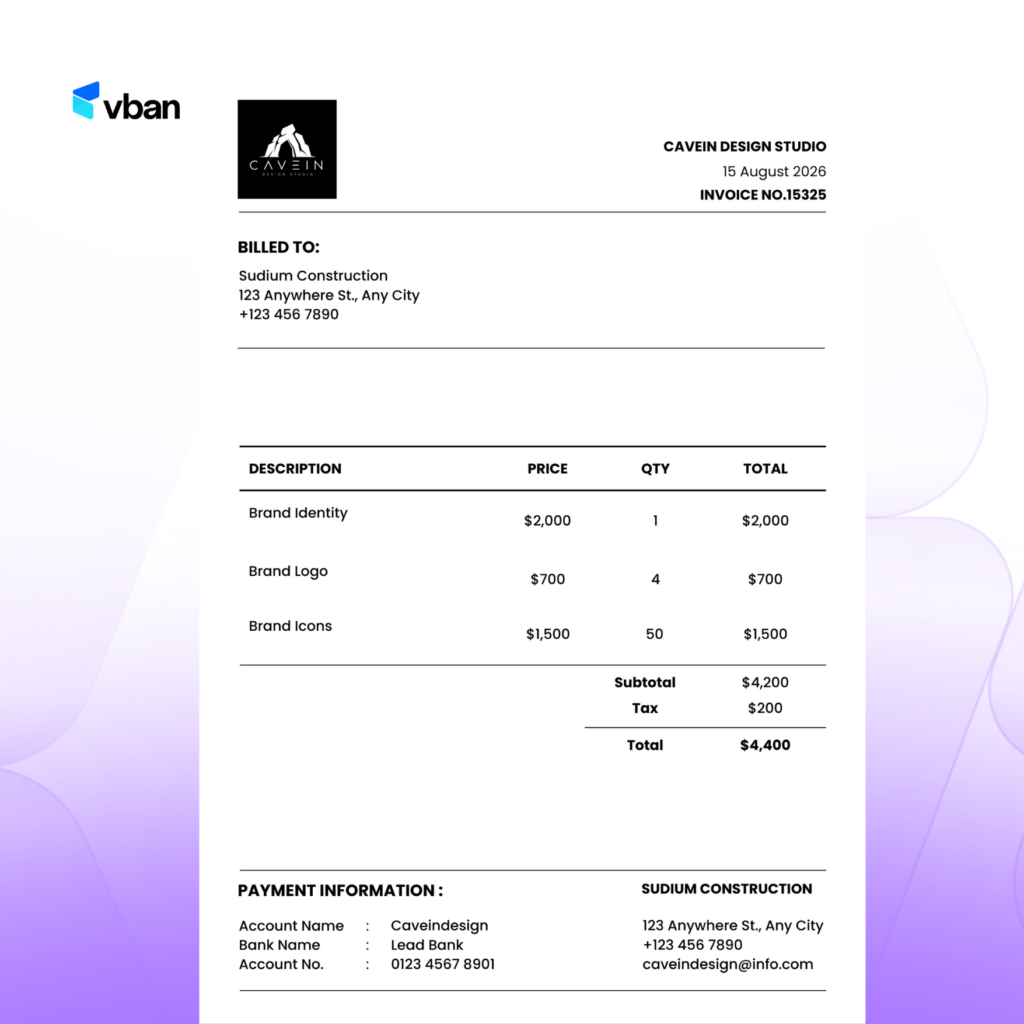
Access the free Vban freelancer invoice template here (Canva)
You can design your invoice with:
- Canva
- Google Docs
- Notion
How to receive payment as a Freelancer with international clients
Understanding how to get paid as a freelancer is just as important as setting the right price.
Before sending your invoice, confirm:
- The currency the client will use
- The payment method
- Who will cover the transfer fees
- The expected payment date
- The account details the client needs
- Whether your account supports the payment currency
For freelancers wondering how to receive payment as a freelancer, Vban provides eligible users with virtual USD, GBP and EUR accounts for receiving supported international payments.
You can create your account, complete verification and add the relevant Vban account details to your invoice. Once the payment arrives, you can manage, convert or withdraw the funds smoothly.
Set profitable freelance rates and receive more of what you earn
Knowing how much to charge as a freelancer is not about choosing the highest or lowest price. It is about setting a rate that reflects your costs, skills, time, value and the realities of working with international clients.
To price your freelance services, start by calculating your minimum rate. Choose the right pricing model, define the project scope, account for payment costs and state your terms clearly.
A professional rate card helps clients understand your offer. A clear invoice helps you get paid correctly. And the right international payment method helps you receive more of what you earn.
Frequently asked questions about how to price your services as a freelancer.
- How much should a beginner freelancer charge?
A beginner should calculate a sustainable minimum rate based on expenses, income goals and realistic billable hours. Your starting price should also reflect the complexity of the work and the value provided to the client.
- Should freelancers charge in foreign currency?
The best currency depends on the client’s location, the project duration and the payment method. For international clients, quoting in USD, GBP or EUR may reduce confusion, provided you have a suitable way to receive the currency.
- How do I calculate my freelance hourly rate?
Divide your monthly revenue target by the number of hours you can realistically bill each month.
For example: $2,400 monthly target ÷ 80 billable hours = $30 per hour
- Should I request a deposit first?
A deposit can reduce the risk of non-payment, especially for new clients or large projects. The percentage should be agreed before work begins and included in the contract.
- What should I include in my freelance rate card?
Include your services, starting prices, package details, turnaround times, revision limits, add-ons, accepted currencies and payment terms.
- What should I include in an invoice?
Include your details, the client’s details, invoice number, dates, service description, total amount, payment currency, payment instructions and due date.
- How can freelancers in Nigeria receive international payments?
Freelancers can use Vban’s virtual USD, GBP and EUR accounts to receive international payments in supported currencies.
Create a free account on the Vban app, complete the required identity verification and generate the available foreign-currency account details. You can then add those details to your invoice and send them to your international client.