


Lagos, Nigeria:
The rise of remote work has opened global opportunities for professionals across Africa. Designers, developers, marketers, and creators now collaborate with clients and companies thousands of miles away, often earning their income in foreign currencies.
Yet while work has become borderless, payments have not always kept pace. Many freelancers still rely on international bank transfers that can take several days to settle and often come with intermediary fees.
This mismatch between the speed of digital work and traditional banking has pushed many professionals to explore newer payment infrastructure built for the internet era. Stablecoins such as USDT and USDC, which move on blockchain networks, are increasingly being used as a faster way to move value globally.
As interest in these payment methods grows, fintech platforms are beginning to integrate stablecoin infrastructure alongside conventional banking rails to give users more flexibility.
One such platform is Vban.
What does Vban do?
Vban is a fintech company serving freelancers and remote workers across Africa. The platform enables users to:
- Receive payments in USD, GBP, and EUR
- Manage multi-currency accounts seamlessly
- Convert funds into local currencies at competitive FX rates
- Enjoy zero fees on currency conversions and withdrawals
- Make secure online payments using virtual cards
The company recently introduced Stablecoin Deposits, allowing users to receive USDC (USD Coin) or USDT (Tether) directly into their Vban USD account.
With this feature, Vban users can receive funds globally through supported blockchain networks, including Tron (TRC20), Ethereum, Polygon, Solana, and Binance Smart Chain (BEP20).
Once confirmed on the blockchain, the funds are automatically credited to the user’s Vban USD wallet, making them immediately available for swaps, withdrawals, or payments, creating a seamless bridge between global crypto payments and local financial access.
How Stablecoin (USDC & USDT) Deposits Work
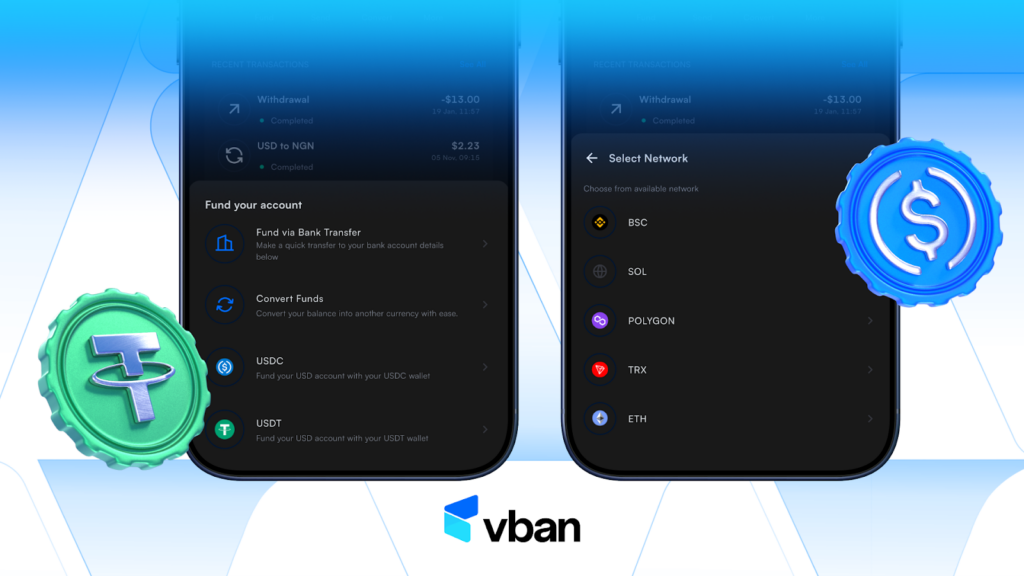
After completing KYC verification in the Vban app, users can generate a unique wallet address for supported stablecoins on supported networks.
Users can then:
- Share the wallet address with clients or senders
- Receive stablecoin payments directly on-chain
- Have funds automatically credited to their USD balance in the Vban app
Stablecoin deposits are converted and reflected as USD, meaning users do not hold or transact with the stablecoin directly inside the app.
Two Ways to Receive USD on Vban
With this launch, users now have two flexible options for receiving USD funds:
- USD Virtual Account: receive bank transfers via ACH or Fedwire
- Stablecoin Deposits: receive USDT or USDC across supported blockchain networks
Both methods give users flexible ways to receive USD globally and manage their funds seamlessly within Vban.
Where You Can Receive Stablecoin Payments on Vban
Stablecoin Deposits are available to users across multiple African markets, enabling freelancers and remote workers to receive payments globally with ease.
- Nigeria: Receive USDT or USDC and convert directly to NGN with competitive FX rates.
- Ghana: Easily receive stablecoin payments and withdraw in GHS.
- Benin & Francophone West Africa (CFA Region): Users in countries using the CFA franc can receive stablecoins and convert to local currency seamlessly.
About Vban
Vban is a fintech platform designed for freelancers, remote workers, creators, and digital businesses across Africa. The mobile app enables individuals to easily own and manage multi-currency accounts, receive payments in USD, GBP, and EUR, and access virtual cards for secure online transactions. Users can also swap currencies with competitive FX rates, helping them keep more of their earnings.
Vban currently serves over 15,000 users across Africa, including Nigeria, Ghana, Benin, and the wider CFA region. The company operates with regulatory registrations from FINTRAC in Canada and FinCEN in the United States, supporting its mission to provide secure and accessible global financial services for Africa’s digital workforce.
Learn more at www.vban.com
Last modified: August 24, 2026